Sharing science comics with kids
XKCD has been part of my life since I was at University, sometime after I started studying engineering but before I started studying law.
For anyone that hasn’t heard of it, it’s a “webcomic of romance, sarcasm, math and language” with an unpronounceable name. The author, Randall Munroe, was a roboticist and leans into the geekier side of life: a lot of the humour is observational joking about how different domains interact, and I’ve learned a lot over the years reading it. Now you can too![^explain]
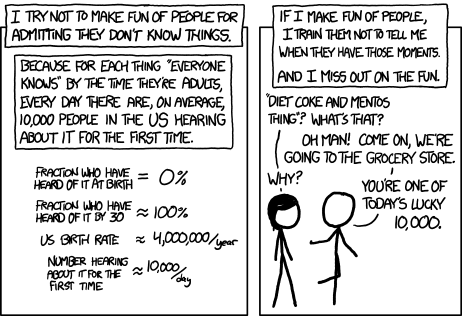
Recently my kids became two of that day’s lucky ten thousand, when they caught me reading it and enjoyed some frames - it turns out to be a good way for them to learn too and share the joke. It helps that they’re into science and engineering.
Unfortunately not every comic is kid-friendly. Partly there are the normal things like the occasional swearword, but there are also comics that depend on the zeitgeist of the moment; or an adult’s daily experience over years; or assume knowledge of concepts that are way beyond my power to explain them, like calculus. There are also some cartoons that are a bit too deep or sad.
How to find a way to let kids experience the fun? My solution is to simply pick the cartoons that (a) I think the kids can already understand, or (b) that depend on a topic that I can explain easily without the joke being ruined. If the topic can be explained and the joke still lands as funny afterwards, that’s a double win in my book.
Everyone knows that explaining the joke is a good way to ruin it, but xkcd is a bit different for a couple of reasons. First, it’s based on breadth of knowledge that very few people have anyway, and that makes it a good and fun way to learn about new concepts. Second, if the explainxkcd Wiki is anything to go by, there’s a large population of people out there who routinely want the joke explained anyway.
After going through half the comics, about one third of the comics are kid-friendly by my heuristic.More precisely: 619 out of 1794 or about 34.4%
I’ve put them up at tris.sherliker.net/xkcd and you can see them here:
Original Image URL:
XKCD and comics copyright Randall Munroe. Shared under creative commons license CC BY-NC 2.5.
Now, the kids can freely scroll through and get a full experience without me over their shoulder, and we can share the fun of discovering new things together too.
Use of AI
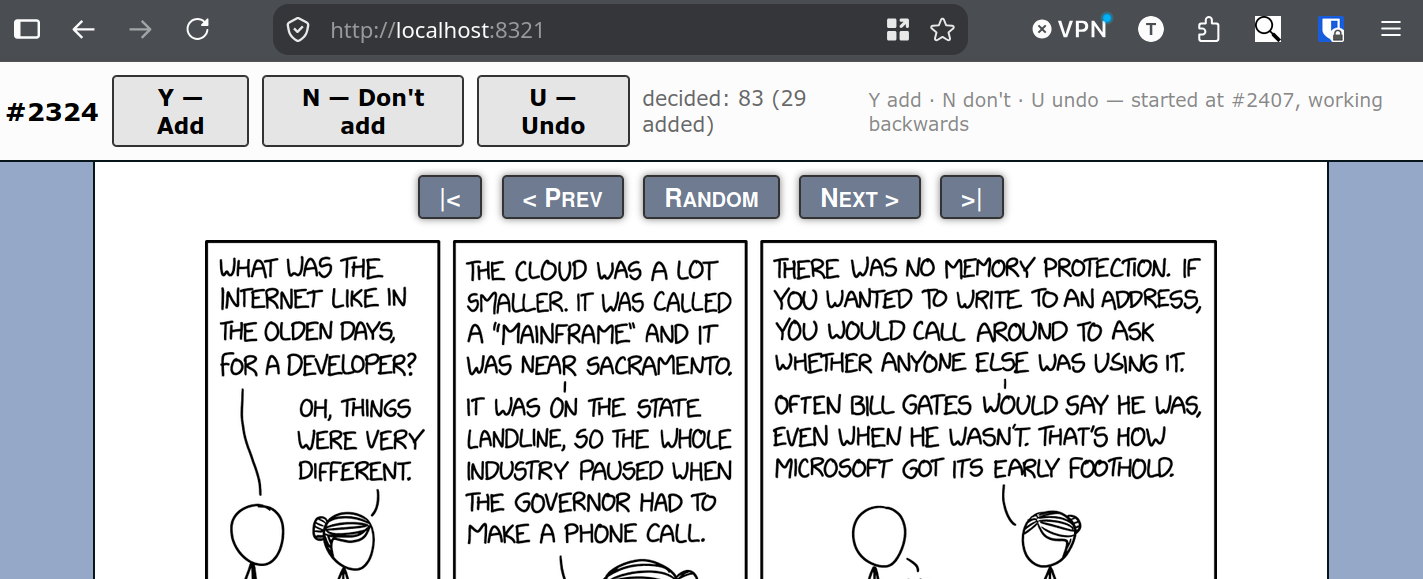
I didn’t use an LLM to make the selection, or to scrape Randall’s site. But I did use it to make a neat UI tool to help me make decisions for each comic with a Y/N keyboard press (shown below), and to make a short script to download the image assets once after I selected them.
Notes of topics I seem to find bad and good
Here are some topics that seem to fare well and poorly on my heuristic.
Bad
- politics
- Vaccines
- Vaccine politics
- Office politics
- The Superbowl and other US culture
- Mental health problems
- Censorship
- Old movies
- Disease
- 90s internet conventions
- Calculus
- The Demon Core tragedy
- Observational humour that depends on overlapping terminology between three scientific disciplines
- Etymology
- Sports brackets
- The international phonetic alphabet
- How mobile phones have developed over the past two decades
- Cable connections
- Two-factor authentication
- Star Trek
Good
- Syllogisms
- Space
- Unit conversions
- Physics and Chemistry topics other than quantum mechanics
- Measurement error
- Scientific abstractions
- Dinosaurs
- Things that seem like they shouldn’t work, but they do
- Observational humour that doesn’t depend on overlapping terminology between three scientific disciplines
- Star Wars, the original three movies
Graph of selections
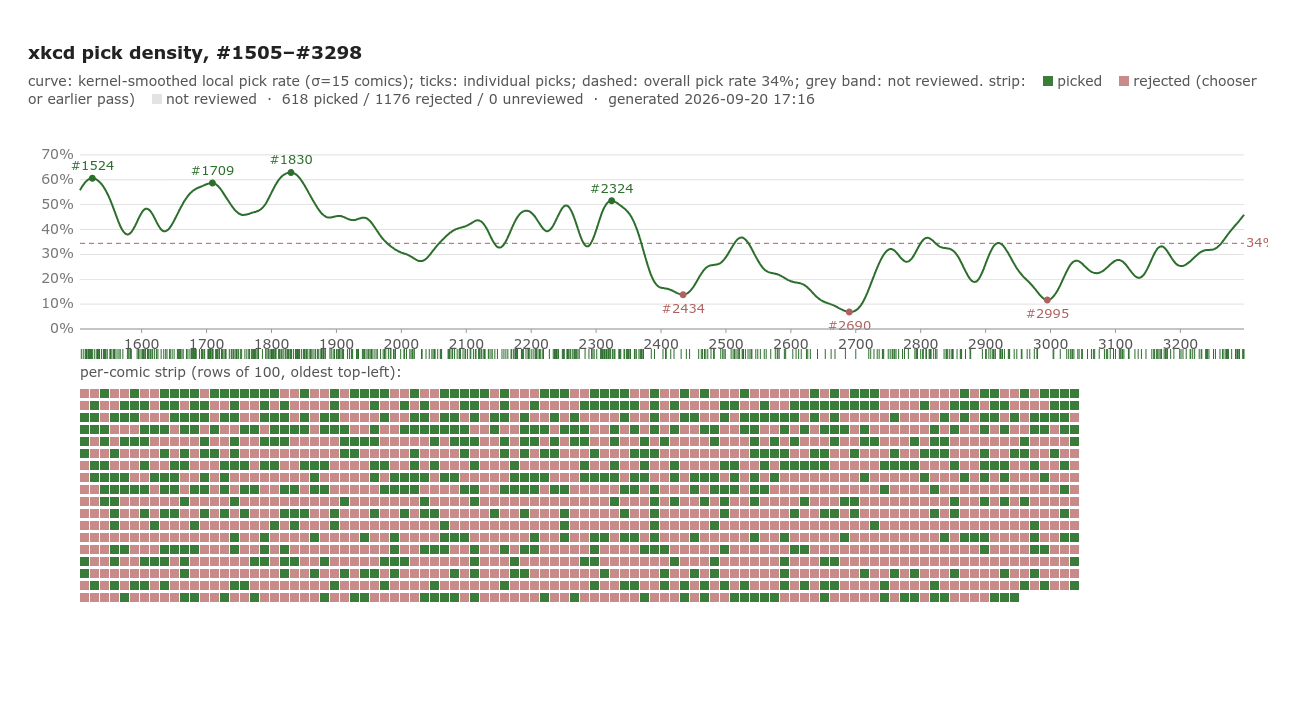
Out of interest I had Kimi-K3 graph the selections I’d made to see if there were any trends. This covers the most recent ~50% of cartoons. There’s no point reading too much into my unscientific selections, but you can see the sudden drop during Covid when disease and politics became heavy burdens on everyone and xkcd was no exception. Click to expand.